

TL;DR abstract. Smart Bidding does not optimize toward your business. It optimizes toward one column, and what goes into that column is a set of settings. In Google’s own words, primary conversion actions are the ones “reported in the ‘Conversions’ column in your reports and used for bidding as long as the standard goal they are part of is used for bidding”, while secondary actions are “for observation only”. Google also publishes plain guidance on how to count them: “One” suits leads, “Every” suits sales.
Everyone already knows the rule. What has not been measured is how often live accounts still do the other thing. Across the managed portfolio we read every conversion action inside that column: 285 of 558 lead-type actions are set to count every conversion, and four in five accounts holding any lead action have at least one set that way. The likely cause is not ignorance, it is the default: Google’s own default for website conversion actions is “Every”, which is right for purchases and wrong for most leads. This is a settings audit from a July 2026 snapshot of one agency management account. It measures configuration, not conversion volumes and not bidding outcomes.
The “Conversions” column looks like a fact about your business. It is a container. The contents are choices someone made, often years ago, often by accepting a default in a setup wizard. That matters because the platform’s other headline numbers already fail to rank outcomes: only one of four native Google scores behaved as promised when we tested them.
We took the managed portfolio and listed every conversion action Google was including in that column at snapshot time: 1,611 actions, removed actions excluded. Then we read the two settings that decide what the bidding algorithm is actually being paid to produce.
The median account bids on six things at once
The median account has 6 conversion actions inside the bidding column, with the middle half of accounts holding between 3 and 12.5. The heaviest account in the snapshot has 190.
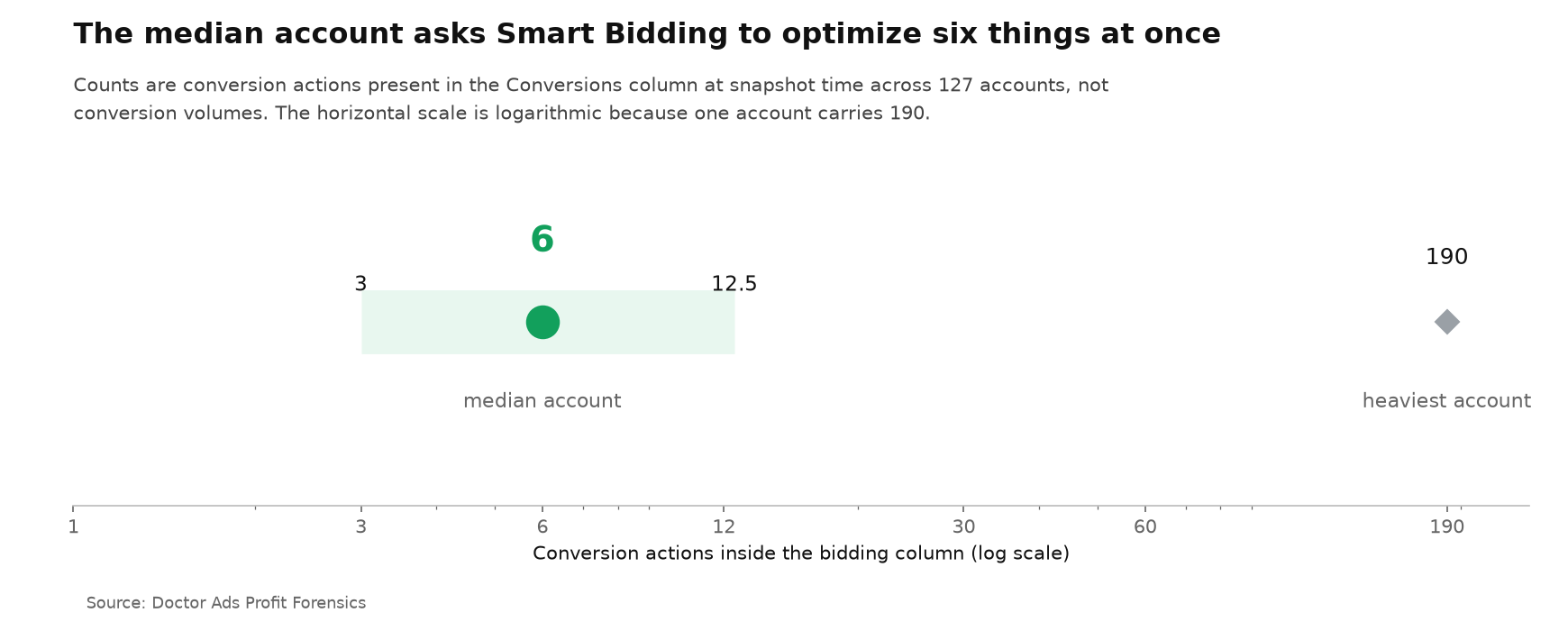
Six is not automatically wrong. A business can genuinely sell a product and book a call and want a bid on both. But six actions is six definitions of success arriving as one count. Whether they are also one currency depends on whether values are attached and on whether the campaign bids to conversions or to conversion value, and this snapshot contains neither.
The lead is counted like a sale, and the default is why
Google publishes a plain recommendation on how to count each type: “Every” for sales, “when every conversion likely adds value for your business”, and “One” for leads, “when only one conversion per ad click likely adds value”. A person who fills your contact form twice in one session is one lead. A person who buys twice is two sales.
Inside the bidding column, 285 of 558 lead-type actions, or 51.1%, are set to count every conversion. Purchase and paid-subscription actions run the other way: 193 of 227, or 85.0%, count every conversion, which is what Google advises.
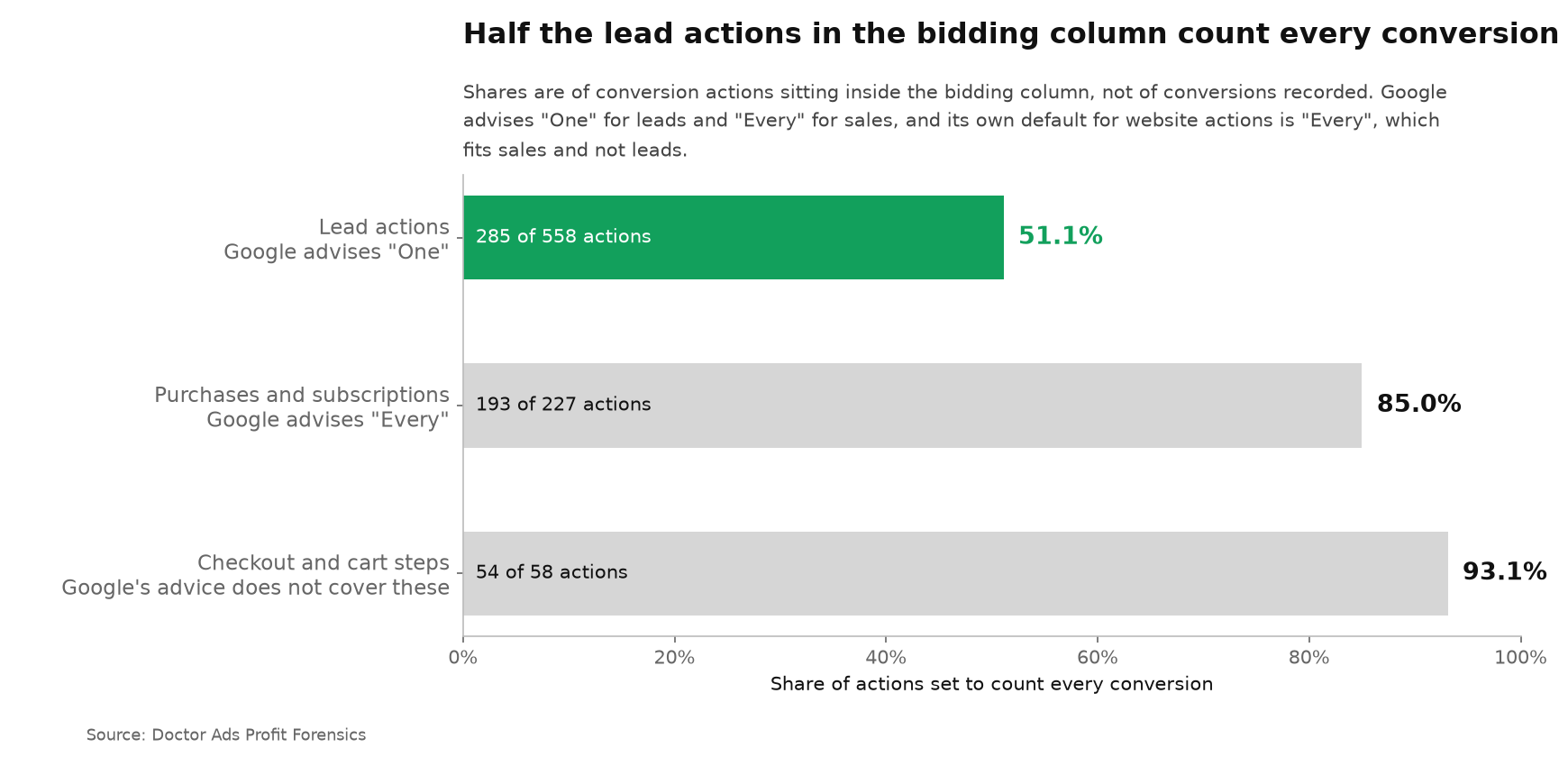
Resist the flattering reading, which is that these accounts understood the rule for sales and forgot it for leads. The simpler explanation is written in Google’s own documentation: the default counting setting for “website, in-app actions, Analytics transactions, clicks on your number on your mobile website, and import conversion actions” is Every. Website purchases and website lead forms ship with the same default. That default happens to match Google’s advice for sales and contradict it for leads. Sales looking correct is what an untouched account looks like. We did not observe who changed which setting, and nothing here shows anyone did.
The reach is wide: four in five accounts that keep any lead action in the bidding column (80.6%) have at least one counting every time. In the median such account, half of the lead actions are set that way. Drop any single account and that median stays at exactly 50.0%.
What the setting can and cannot do to your bidding
Classic computing has a phrase for feeding bad input to a machine and trusting the output: garbage in, garbage out. Automated bidding is the version where nobody checks. The algorithm does not audit the number, it optimizes it.
The honest limit of this study sits right here. We measured a setting, not a spend shift. This snapshot cannot show that Smart Bidding actually chased repeat submitters, because it contains no conversion volumes, no duplicate rates and no outcomes. What it shows is narrower: in 285 of 558 lead-type actions, the number being fed to bidding is permitted to count the same click more than once. Whether that permission is being exercised, and by how much, is a question your own account can answer and this one cannot.
Google supplies the instrument for that. Each conversion action reports a Repeat rate, which Google defines as “effectively the number of conversions you would have recorded using the ‘every conversion’ setting divided by the number you would record using the ‘one conversion’ setting.” A repeat rate of 1.0 means the setting changes nothing for you. A repeat rate of 1.4 means roughly 29% of what that action reports is a repeat of a click you already counted.
The largest category in the column is Google’s catch-all
While we were in there we read the category each action declares. The single biggest group is the catch-all one, which the interface offers as “Other” and the data feed returns as DEFAULT: 453 actions across the managed portfolio, 28.1% of the whole bidding column. It is a real category in the sense that somebody selected it, and a useless one in the sense that it says nothing about what happened. Those actions fall into neither the lead group nor the sale group, so the 51.1% and 85.0% figures describe only the remainder that carries a meaningful label. We cannot tell whether the catch-all ones are mis-tagged leads, sales or noise.
Of the meaningfully labeled ones, about six in ten accounts (59.1%) keep at least one soft action inside the bidding column: a page view, an engagement, a file download, an outbound click, a directions request, a follow-on video view. Watching those is reasonable. Bidding toward them should be a decision, and Google’s primary and secondary split exists precisely so it can be one.
Across all 1,611 actions in the column, 72.6% count every conversion. In about a quarter of the accounts, every single action in the column does.
The five-minute check
- Open Goals, then Conversions, then Summary. Filter to actions marked as primary. That list, and nothing else, is what your bidding is chasing, provided the goal it belongs to is being used for bidding.
- Read the Count column and the Repeat rate together. A lead action on “Every” with a repeat rate of 1.0 is harmless. The same action at 1.4 is inflating that action’s reported conversions by about 29%.
- Move watchers to secondary rather than deleting them. Secondary actions still report in “All conversions” and stay out of the bidding math, which is exactly what a page view or a download should be doing.
- Change one action at a time, and expect a step down. Google is explicit that “any changes to conversion count settings will only apply to future conversion reporting”, so history will not move and the reported count will fall from that day. Give the bid strategy a full conversion cycle before you touch the target, and do not do this at all in a campaign that is already short of conversion volume.
- If your impression volume is the worry rather than the count, check which of the two impression-loss columns is actually larger before touching budgets.
The researcher’s take
The interesting part of this is not that accounts are sloppy. It is how quietly a default becomes a decision. Somebody sets up website conversion tracking, accepts what the wizard offers, and that choice is correct for the purchase and wrong for the contact form, in the same account, on the same day, with nobody ever making a call about it. Then automated bidding arrives and starts spending against the result. I am not going to tell you that fixing the Count column will lift your revenue, because this study cannot show that and I did not measure it. I will tell you that the number your bidding chases should be a number you chose. Read the Count column and the Repeat rate tomorrow. It takes five minutes and it is the cheapest audit in the account.
Method and data statement
Doctor Ads Profit Forensics is the research desk of a Google Ads practice with 19 years and $770M managed spend behind it.
Source: one snapshot of an agency management account, exported through a read-only API window on July 10, 2026. Accounts are pseudonymous. The population is every conversion action flagged for inclusion in the “Conversions” metric whose status is not removed: 1,611 actions across 127 accounts. The counting setting is read from the action’s own counting type, where “Every” corresponds to many-per-click and “One” to one-per-click. Lead-type actions declare the categories lead form submission, contact, phone call lead, appointment booking, quote request, signup, qualified lead, imported lead or converted lead: 558 actions across 98 accounts. The narrow sale group is purchase and paid subscription: 227 actions across 71 accounts, of which 193 count every conversion (85.0%). The wider sale group adds checkout started and add to cart, 58 further actions of which 54 count every conversion, giving the 285-action group its 86.7%. Google’s counting guidance addresses sales and leads, not funnel steps, which is why both versions are published here. Actions declaring DEFAULT, 453 in 67 accounts, are reported separately and excluded from both groups. Shares are of actions, not of recorded conversions, and each account-level figure was calculated inside the account before any median was taken. The per-account median share of lead actions counted every time was recalculated 98 times with one account removed each time and did not move from 50.0%. To reproduce, export conversion action name, category, counting type and include-in-conversions flag for each account and cross-tabulate category against counting type. This snapshot is a different population from the $133M corpus used in our other studies.
Limitations
- Settings, not volumes. We measured how actions are configured. We did not measure how many duplicate conversions those settings produced, whether bidding shifted, or what any of it cost.
- Defaults are unobservable. The snapshot shows the current setting, not who set it. The default explanation is the most economical reading of the pattern, not an observation.
- Category is self-declared. The category on a conversion action is chosen by whoever created it, and 28.1% of the column declares no usable category at all.
- The bidding condition is conditional. Google’s wording is that primary actions are used for bidding “as long as the standard goal they are part of is used for bidding”, and a secondary action inside a custom goal is used for bidding. Our population is built from the inclusion flag rather than from goal membership, so a small number of edge configurations sit on either side of that line.
- No performance claim. Nothing here shows that these accounts perform worse because of the setting, in the same way that a high Optimization Score did not predict better campaign outcomes.
- Managed portfolio. These accounts are professionally managed, which if anything should raise the standard of setup compared with the wider population.
Key Takeaways
- Google advises “One” for leads and “Every” for sales. In this snapshot 51.1% of lead-type actions inside the bidding column count every time.
- 79 of 98 accounts have at least one lead action counted every time. In the median such account, half of them are.
- Google’s default for website actions is “Every”. That is the likely reason sales look correct and leads do not, rather than the rule being understood on one half.
- 28.1% of the bidding column sits in Google’s catch-all category. The lead and sale figures describe the meaningfully labeled remainder only.
- Repeat rate is the number that tells you whether it matters in your account. At 1.0 the setting is cosmetic; at 1.4 roughly 29% of that action’s reported conversions are repeats.
When this does not apply
Genuinely repeatable lead events. Some businesses receive several distinct inquiries from one session, for different properties, dates or vehicles. There “Every” is the honest setting and the default is right by accident.
Accounts short of conversion volume. Below the volume automated bidding needs in order to learn, cutting the reported count can starve it further. Fix volume first, then precision.
Custom goals built deliberately. If a secondary action sits inside a custom goal on purpose, it is in the bidding math by design, and this audit reads it as an exception rather than a defect.
This analysis describes observed portfolio settings and does not guarantee the same configuration or result in another account.


