

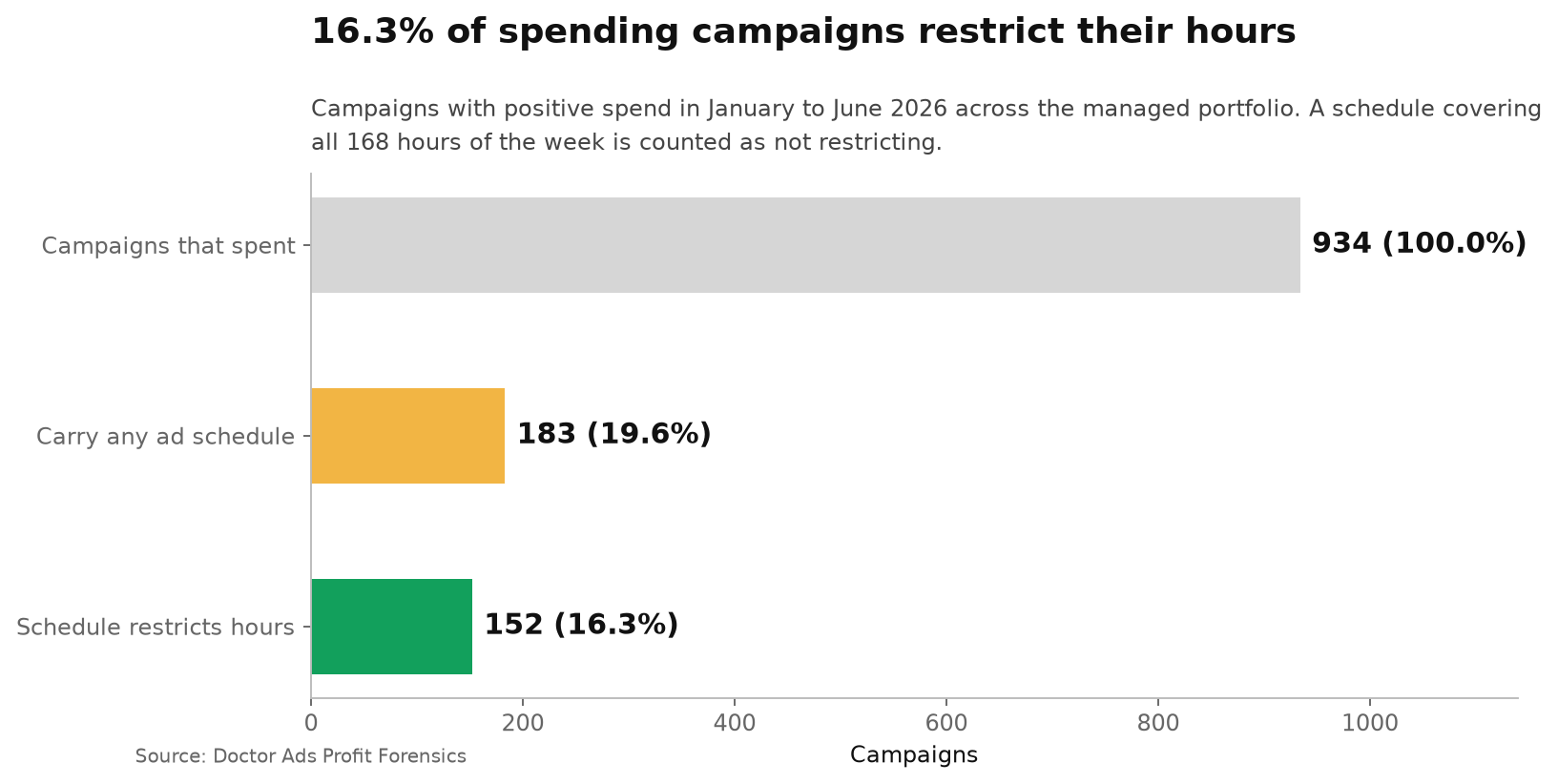
TL;DR abstract. Google Ads campaigns run around the clock unless somebody tells them not to. Doctor Ads Profit Forensics counted how often anybody does. Of the 934 campaigns that actually spent money in the first half of 2026 across the managed portfolio, 19.6% carried an ad schedule of any kind, and only 16.3% carried one that restricts hours. In the median account running at least three campaigns, there were none at all.
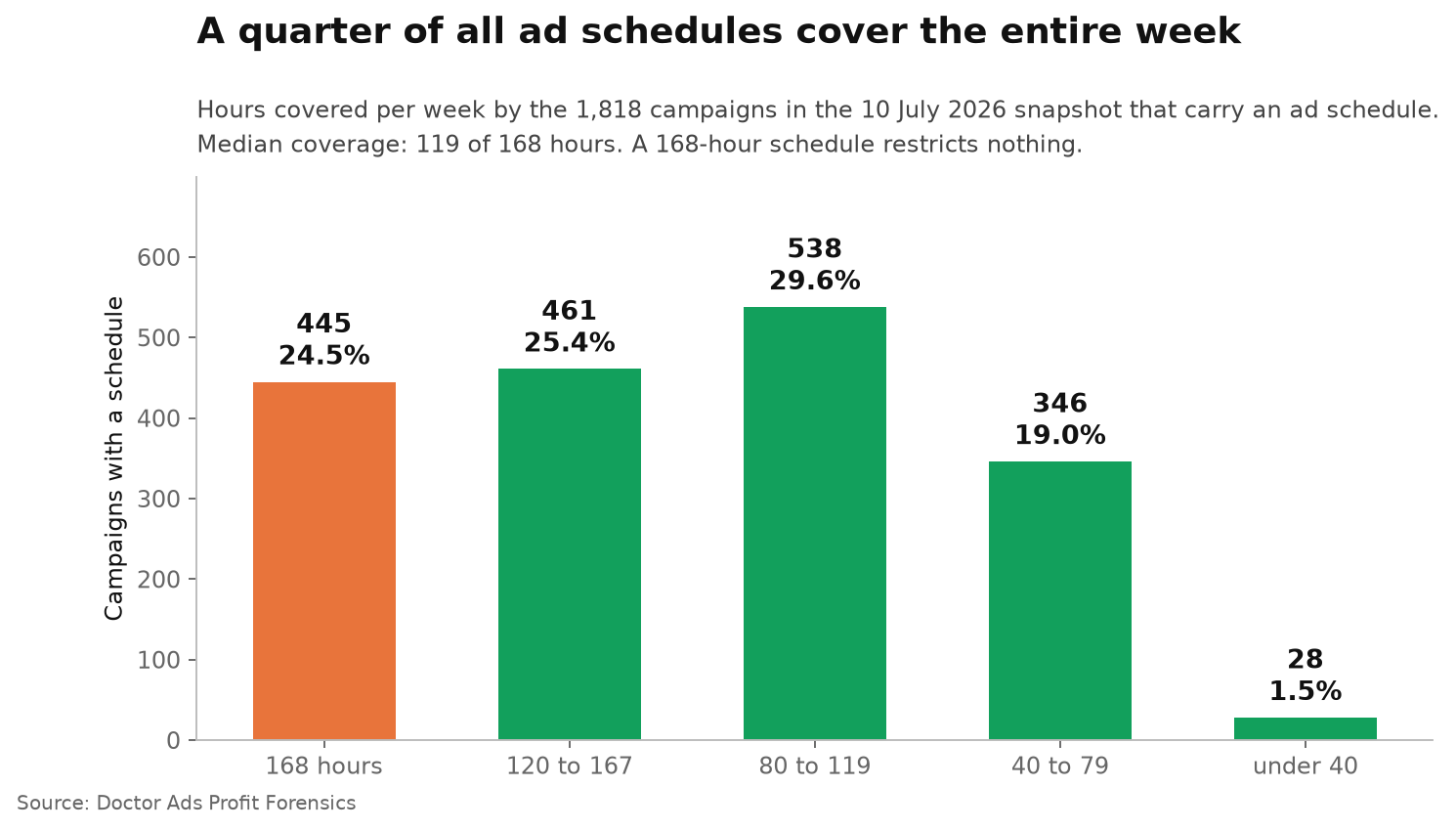
The gap between those two numbers has a reason. Among all 1,818 campaigns in the snapshot that carry a schedule, 24.5% cover the full 168 hours of the week, which is a schedule that forbids nothing. Measured in money, 88.4% of first-half spend ran through campaigns with no hour restriction at all. A separate older corpus exported from the interface, different advertisers and different years, points the same way: only 1.2% of its campaigns carry a schedule that narrows the week. This is a census of a setting, and it is not an argument for switching it on: under Smart Bidding, cutting hours removes auctions the bidding system might have won profitably, and it does so before the system can value them.
Google states the default plainly. “By default, your Google Ads campaigns are set to show ads ‘All day.’ This means your ads are eligible to appear throughout each calendar day.” Everything else in this article follows from that sentence: the schedule is an opt-in, and opting in is rare.
How often do advertisers take that option? The only published figure we could find is a survey: in its 2012 Search Marketing Benchmark Report, MarketingSherpa reported that 41% of 1,530 surveyed organisations said they used ad scheduling. That is a self report, by organisation, from 2011. Nobody appears to have counted the campaigns themselves. So we counted them.
16.3% of spending campaigns restrict their hours
We took every campaign in the portfolio with positive spend between January and June 2026: 934 campaigns. Of those, 183 carried an ad schedule at all, and 152 carried one that leaves at least one hour of the week uncovered.
That is 19.6% with a schedule and 16.3% with a restriction. The difference is not rounding: 31 of those 183 scheduled campaigns, 16.9%, carry a schedule that covers the whole week and therefore restricts nothing. The next section shows the same pattern on the wider snapshot.
Widen the denominator to every campaign in the snapshot, including the paused and removed ones, and the picture holds: 13.4% of all 10,225 campaigns in the snapshot carry a restrictive schedule.
A quarter of all schedules cover all 168 hours
Among the 1,818 campaigns in the snapshot that have a schedule, 445 of them, or 24.5%, cover the entire week: seven days, midnight to midnight. The schedule exists as an object, and it restricts nothing.
This is not a data artefact. Google Ads Editor treats it as a normal state and displays the schedule column as the share of the week your ads are eligible to run, showing None when there is no schedule at all. Some practitioners build a full week schedule deliberately, as a scaffold for reading performance by hour later, and say so in public.
The median scheduled campaign covers 119 of 168 hours. So among the minority that schedule, most do restrict something, and a quarter do not.
Putting the two counts together: of every 100 campaigns that spent money in the first half of 2026, about 20 had a schedule and about 16 had one that actually narrowed the week.
88.4% of the money ignores the clock
Campaign counts flatter small campaigns. Money is the better denominator, and it moves the number the other way. Of $3,453,415 spent in the first half of 2026, $3,051,958, or 88.4%, was spent by campaigns that carried no restrictive schedule at the July snapshot. We do not know what schedule each campaign had in February; settings history is not in the export, so this is spend attached to a July state, not a record of conditions at the time.
The account level view is starker still. Among accounts with at least three spending campaigns, the median share of campaigns with a restrictive schedule is 0.0%. About six accounts in ten have no hour restriction anywhere, and fewer than one in ten restrict every campaign. The rest use it on some campaigns and not others, so among the accounts that use the control at all, selective use is the normal pattern.
Automation does not explain the absence
The obvious guess is that Smart Bidding made the control obsolete, so advertisers stopped setting it. The counts do not fit that guess, though they cannot tell us what advertisers were thinking.
Campaigns on Maximize Conversions restrict hours 19.2% of the time, which is above the pack average, not below it. Manual CPC campaigns restrict hours 37.5% of the time, on a small base of 48 campaigns. By campaign type, Search restricts in 20.7% of cases and Performance Max in 16.0%.
Google is explicit that the schedule survives automation. “While Smart Bidding strategies don’t use your manual bid adjustments (for example, +20% on Saturdays), they do respect your Ad Schedule settings.” What automation ignores is the hourly bid modifier, not the hours themselves. So the two are technically compatible, and campaigns on automated strategies restrict hours at least as often as the rest. Why so few advertisers use the control at all is a question these records cannot answer: a deliberate preference for leaving the bidding system unconstrained looks exactly like never having opened the tab.
A second corpus, different advertisers, same direction
The finding rests on one snapshot, so we checked it against an older and separate corpus, whose campaign settings were exported from the Google Ads interface rather than read through the API, covering earlier years and mostly different advertisers. There, 134 of 10,856 campaigns, or 1.2%, carry a label other than “All day” or “All day, adjusted bids”, which is the interface’s way of saying the week has been narrowed. In four out of five of its accounts with at least three campaigns, not one campaign narrows it.
The two numbers do not match, and we are not going to pretend they do. Against all campaigns, the snapshot gives 13.4% restrictive and the older corpus gives 1.2%. Different advertisers, different years, and a different recording layer: one counts schedule criteria through the API, the other reads a label in an export. What both agree on is the direction: a campaign with restricted hours is a minority case in every account list we have.
Does any of this mean you should switch dayparting on?
No, and this is the part the how-to literature skips. Under Smart Bidding, cutting hours removes auctions that the bidding system might have won profitably, and it does so before the system gets a chance to value them. The published claims that dayparting saves 15% to 35% of budget come from vendor pages without a stated sample, and the case studies behind them are single accounts where several things changed at once.
What the census does say is that the control is rarely used. Our own earlier study of the same portfolio found that the median account spends about half its budget in hours that perform below its own daily click-through rate. That study measured where the money goes. This one measures how many campaigns carry an instruction about where it should go. The first says the clock is worth looking at; the second says few campaigns carry a rule about it, for reasons this data does not record.
When this does not apply
You run a business that never closes. For ecommerce or an app with global demand, a full week schedule is the correct answer, and the absence of a restriction is a decision rather than an oversight. Our count cannot tell those apart.
Your schedule exists to read reports, not to restrict. A deliberate seven-day, 24-hour schedule split into blocks is a legitimate reporting scaffold. It lands in our 24.5%, correctly counted as restricting nothing, though your intent was never to restrict.
The June 2026 pacing change overlaps this window. From 1 June 2026 Google paces campaigns whose schedules turn off whole days against 30.4 times the average daily budget, and states that the change “does not impact ad schedules that turn off campaigns for specific hours within a day”. Our spend window runs to the end of June and the settings snapshot is later still, on 10 July, so the measurement sits across that date rather than before it. It cannot describe scheduling behaviour as it was before the change.
You manage a portfolio like ours. This is an agency managed portfolio, not a random sample of advertisers. Accounts here have been through audits, which if anything should raise the adoption of a basic control, not lower it.
You are comparing with MarketingSherpa’s 41%. That number counts organisations who said in a survey that they used ad scheduling, in 2011. Ours counts campaigns that carry the setting today. A single scheduled campaign in a large account makes that organisation a user of dayparting and barely moves our share. The two are not a before and after.
How to check yours in two minutes
- Open a campaign and go to Schedules. If the table is empty, your campaign runs all week by default and you have your answer.
- If rows exist, add up the hours they cover. Seven rows of midnight to midnight is 168 hours, which is the same as having no schedule at all in delivery terms.
- In Google Ads Editor, the schedule column shows the share of the week your ads are eligible, so a column full of 100% tells you the same thing across the account at a glance.
- Before you cut hours, check whether the campaign uses Smart Bidding. The hours will be obeyed, the bid adjustments will not.
Key takeaways
- Of campaigns that spent in the first half of 2026, 16.3% carried a schedule that restricts hours, and 19.6% carried one of any kind.
- Among all scheduled campaigns in the snapshot, 24.5% cover the full 168 hours, so the schedule restricts nothing.
- 88.4% of first half spend ran through campaigns with no hour restriction; in the median account no spending campaign restricted hours.
- Automation does not explain it: Maximize Conversions campaigns restrict hours 19.2% of the time, at least as often as the rest, and Google states that Smart Bidding respects ad schedules.
- In a separate older corpus only 1.2% of campaigns narrow the week, agreeing in direction but not in magnitude.
Researcher’s take
When I open an account, the schedule tab is one of the fastest tells I know. Not because an empty schedule is wrong, but because of what the answer to the next question usually is. If I ask why the campaign runs at three in the morning and the answer is a reason, the account has been thought about. If the answer is that nobody looked, then the same is usually true of three other settings I have not checked yet. The schedule is cheap to inspect and it tells you whether the defaults in this account were chosen or inherited.
Igor Ivitskiy, Doctor Ads · 19 years · $770M managed spend
Method
Doctor Ads Profit Forensics is the research desk of a Google Ads practice with 19 years and $770M managed spend behind it.
Data statement v.2026.09. Source: campaign level ad schedule criteria and campaign settings for a managed Google Ads portfolio analysed by Doctor Ads Profit Forensics, snapshot dated 10 July 2026, matched with monthly campaign spend for January to June 2026. Accounts are pseudonymised; no campaign, account or vertical name is published.
Definitions. A campaign has a schedule if at least one day of week schedule row exists for it in the snapshot. Hours covered is the sum over those rows of end hour minus start hour; a campaign covering 168 hours restricts nothing and is counted as non restrictive throughout. The primary denominator is campaigns with positive spend in January to June 2026: 934 campaigns in 74 accounts, carrying $3,453,415. The secondary denominator, named wherever it is used, is all 10,225 campaigns of the snapshot in 130 accounts, which includes paused and removed campaigns. Per account figures use the 49 accounts with at least three spending campaigns. Medians and quartiles are computed with a single engine, quantile_cont.
Cross check. The older corpus is a separate export of 28 accounts taken from the Google Ads interface, where the schedule appears as a text label rather than as criteria. A campaign counts as restrictive when its label is anything other than “All day” or “All day, adjusted bids”: 134 of 10,856 campaigns. Labels such as “All days, 12:00 AM – 4:00 AM” describe a narrowed week despite starting with the same two words, and an earlier version of this check wrongly grouped them with the unrestricted ones.
Limitations. Four. The snapshot records the schedule as it stood on 10 July 2026, not its history, so a campaign scheduled in February and unscheduled in May is counted as unscheduled. Intent is invisible: a full week schedule built as a reporting scaffold is indistinguishable from an abandoned one. Spend is matched by campaign, so a campaign that changed its schedule mid window carries its July state. And the portfolio is agency managed, not a random sample of advertisers.
Changelog. First published September 2026. Recomputed quarterly against the live claim registry.
What to read next
- Half of Google Ads spend runs in dead hours, the companion study on where the money actually goes hour by hour.
- What actually gets changed in a Google Ads account, on which settings advertisers touch at all.
- Who actually took the Search partners opt out, the same question asked of a different default.

