Keywords & Match Types
How match types and keyword counts show up in live campaigns.
- $770M+ managed spend
- Since 2006
- #6 in the Top 50 Most Influential PPC Experts
Keywords are where a Google Ads account is decided, and they are also where it is misread. The list of keywords tells you what you asked for, not what you paid for. The match type tells you how loosely you asked. The negative list tells you what you refused, and it is usually the longest document in the account and the least inspected. This section reads those three things together. It is written for the person who signs off a large budget and cannot check every ad group: a marketing director handed a keyword list of unknown quality, a commercial director who wants to know why the cheapest queries keep producing the most expensive leads, or an independent consultant asked whether the account structure is worth what it costs to maintain.
The question this section answers
The buyer question is whether the keyword structure costs more than it earns. That has three parts. How many keywords you are actually carrying, and how many of them ever do anything. What each match type costs you when the click converts. And whether the negative list, the part of the account everyone feels good about, is doing the work people assume it does.
The evidence here pushes against two comfortable beliefs. A wide match type is not free reach, and it is not automatically a disaster either, and the distance between those two claims is a number worth having. A long negative list is not evidence of control, because a list can be long and do nothing. And a keyword that never earns an impression is not a harmless line in a report, since somebody maintains it, somebody bids on it and somebody pays to have it managed.
How to read it, in order
- What broad match costs against exact match inside one account comes first, because it settles the debate most teams still run on opinion.
- How many keywords live in a real ad group comes next, so you can compare your structure with practice rather than with a template.
- How many keywords never earn an impression follows, and it is the study that turns a long list into a work queue.
- Accounts that target a search and block the same search takes you into the negative list, where the most obvious form of untidiness hides.
- What a duplicated negative list looks like from the inside closes the section, and it is the quickest thing on this page to check in your own account.
What this section will not do for you
It will not write your keyword list, and it will not tell you which match type to use, because that depends on your conversion volume, your budget and how much supervision you are willing to fund. Search term quality as a spending problem belongs to the wasted spend section, so this one stays out of it. What you get here is the size of the structure you are paying for, and the part of that structure which does nothing at all. The account management section covers how changes to those lists are meant to be recorded, and the conversions section covers whether the conversions these keywords produce are the ones your business counts.
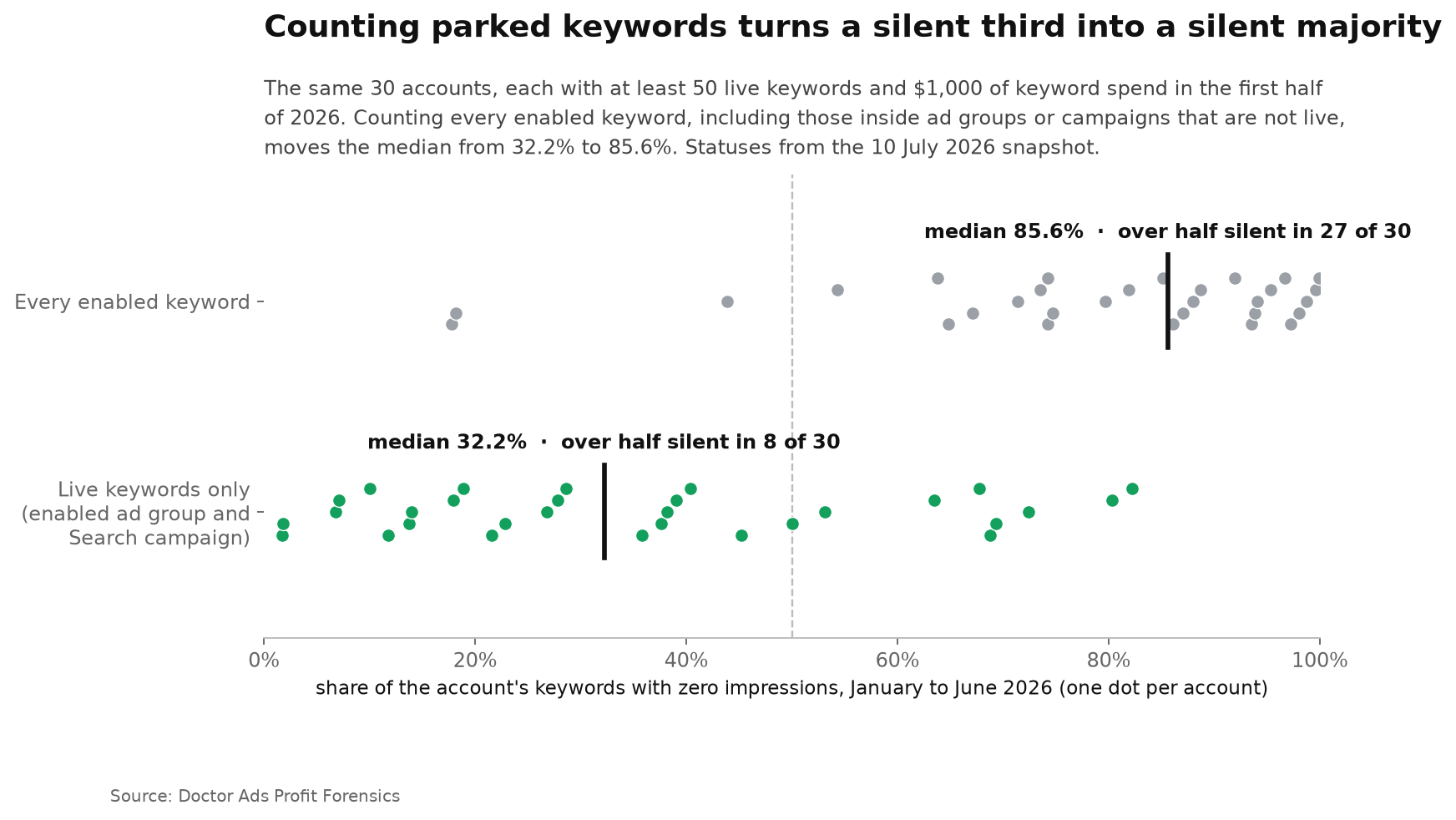
32.2%
How Many Google Ads Keywords Get Zero Impressions? 32.2% or 85.6%, Depending on One Filter
- 48.1%Half the Median Account’s Google Ads Negative Keywords Are Duplicates
- 6.4%How Much More Does Broad Match Actually Cost? 6.4% at the Median
- 7How Many Keywords per Ad Group? Live Google Ads Accounts Use Seven
- 58.4%Broad Match Took 58.4% of Pooled Keyword Spend. The Typical Account Did Not Move
- 34.1%Bid and Blocked: About a Third of Accounts Target and Exclude the Same Search