

TL;DR abstract. That negative keyword lists repeat themselves has been practitioner folklore since at least 2017, when Adalysis used identical per campaign counts as the fingerprint of a copy and paste job. Folklore with no denominator. This page supplies the denominator. A negative keyword is an instruction that stops your ad showing for a search, and at campaign level it applies to that campaign only, which means it does not travel.
Across 102 accounts we read every campaign level negative keyword in place at the snapshot: 1,058,686 of them, spread over 4,263 campaigns, with no missing rows. In the median account, 48.1% of those entries are a word the account already excludes somewhere else, with the middle half of accounts between 17.5% and 74.1%. Pooled across the whole corpus the duplication rate is 75.5%, and it stays at 72.7% when the single largest account is removed. A repeated negative sits in a median of 5 campaigns, and in the worst case in 1,829. The list is long for two reasons at once. About half of the median list is genuinely distinct instructions, which is the internet being the internet. The other half is the same instruction written out again.
Your negative keyword list is not a record of everything you have learned. In the median account, about half of it is the same lesson, written down again.
Every practitioner has had the moment. You open an account you inherited, you click into the negative keywords of one campaign, and there are thousands of rows. It feels like evidence of care. Somebody was clearly paying attention for a long time.
Then you open the next campaign and see many of the same words.
Practitioners have described this pattern for years. Adalysis wrote it up in 2017, using identical per campaign negative counts as the fingerprint of a copy and paste wave (Adalysis, 2017), and under a separate heading describing accounts that carry the same negatives in every ad group. Current audit guides treat it as a routine step: if you are blocking a phrase in five different campaigns, promote it to a shared list. The pattern is not a discovery.
What none of that comes with is a rate. How much of a real negative keyword list is repetition, in what share of accounts, and how far does a single repeated instruction spread? That is the gap, and it is the only thing this page claims to fill.
1,058,686 negatives, and the median account repeats half of them
We took every campaign level negative keyword present at the snapshot in 102 accounts. That is 1,058,686 entries across 4,263 campaigns. Every row carries its text and its match type; none are missing, which matters, because it means this count is not an artifact of a partial export.
For each account we counted the entries, then counted how many distinct combinations of text and match type they represent. The gap between those two numbers is duplication.
In the median account, 48.1% of entries are re-entries of a text and match type the account already excludes somewhere else. The middle half of accounts sits between 17.5% and 74.1%. Expressed the other way round, the median account writes each negative keyword 1.93 times.
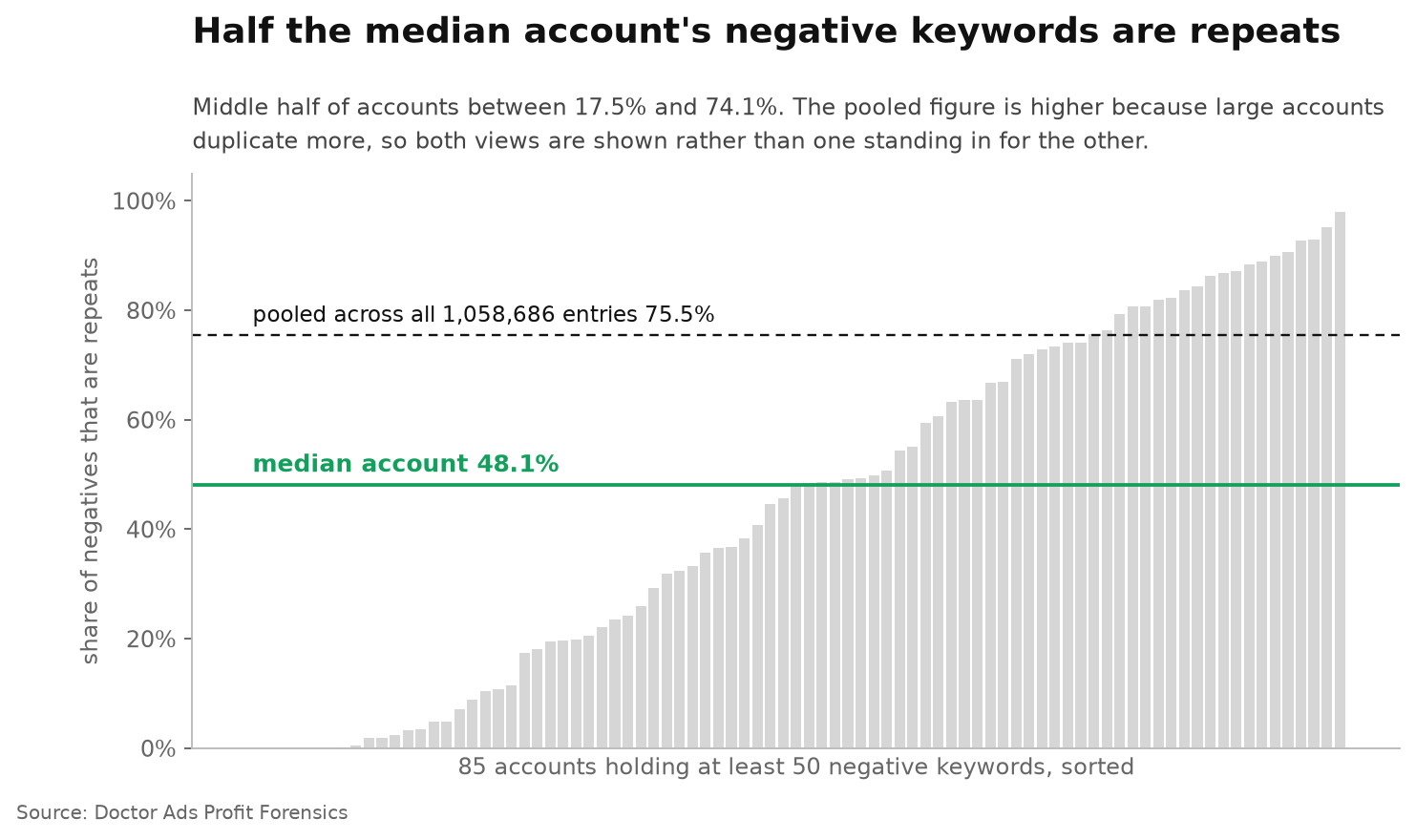
Pooled across all 1,058,686 entries the duplication rate is 75.5%. That number is doing something different from the median and we are not going to let it impersonate the typical account: it is dominated by large accounts, and one account alone holds 23.9% of every negative keyword in the corpus. Remove that account entirely and the pooled rate is still 72.7%. Whichever way you cut it, duplication is the normal state, not an outlier’s problem.
The same word, sitting in five campaigns
Duplication has a shape as well as a size. For every negative keyword that appears more than once inside an account, we counted how many campaigns it sits in.
The median repeated negative is in 5 campaigns. One in ten is in 14 or more. The most repeated single instruction in the corpus sits in 1,829 campaigns of one account.
That last number is not a scandal, it is a diagnosis. Nobody typed a word 1,829 times because they enjoyed it. Somebody, or more likely some script, was solving a real structural problem: a campaign level negative applies to its own campaign and nowhere else, so an account with many campaigns has to state the same exclusion many times for it to hold everywhere.
At least one shared negative list is attached in 79 of 102 accounts
Here is the twist that changes what this finding means.
Google has a purpose built answer to exactly this problem. A shared negative keyword list is written once and attached to many campaigns, so the instruction lives in one place. Every guide recommends it. Every audit checklist asks for it.
79 of the 102 accounts already have at least one shared list attached to a campaign. The feature is not unknown here, and it is not sitting unattached in a corner.
What we cannot tell you is whether those lists already contain the words being duplicated at campaign level, because our snapshot does not resolve shared list contents. So attachment proves the tool is known. It does not prove the tool was applied to these particular rows, and it does not prove the standard advice failed. It proves the standard advice cannot be verified as sufficient from this snapshot, which is a weaker and more honest statement.
What the numbers do support is a workflow observation rather than a verdict. Campaign level negatives are added where the bad query is noticed, which is inside one campaign’s report, and the exclusion box in front of you there is that campaign’s own. Duplication is not ignorance of the feature. It is the shape of excluding things in the place where you see them.
Why the pile never stops growing
The second half of the mechanism is written in Google’s documentation. Negative keywords do not match close variants. Casing and misspellings are handled for you, but plurals, singulars and synonyms are not: if you want them excluded, you add each one yourself.
Set that against a matching system whose entire job is to find new phrasings for the same intent. One side produces variants automatically. The other side blocks them one literal string at a time, by hand. There is no version of that arrangement in which the list stops growing.
Which is why the sizes look like this. The median account carries 1,046 campaign level negative keywords. The middle half carries between 277 and 3,990. The top tenth carries 20,160 or more, and the largest single account in the corpus carries 253,049.
None of those accounts is badly run. They are accounts that have been paying attention for several years, in a system that charges for attention in rows.
The match type number that will mislead you
One more cut, included specifically because it is the number most likely to be quoted wrongly, including by us if we were not careful.
Pooled across the corpus, 50.4% of negative keywords are exact match, 41.8% are broad and 7.8% are phrase. That looks like a finding about how practitioners exclude things.
It is not. In the median account, exact match negatives are only 7.0% of the list, and the middle half of accounts sits between 0.7% and 45.9%. The pooled majority comes from a handful of very large accounts whose scripted exclusion habits are nothing like a typical advertiser’s.
We are reporting both because the gap between them is the useful lesson. When you read any benchmark about account structure, ask whether it is the average of accounts or the average of rows. Rows belong disproportionately to giants, and the giant is not you. It is the same discipline we applied to lost impression share, where the pooled and per account views also disagree.
What this measurement does not tell you
Three honest limits, all of which cut against the finding rather than for it.
Duplication is not automatically waste. A word excluded in five campaigns is doing its job in five campaigns. The cost is maintenance, not necessarily performance: when the instruction changes, you now have five places to change it, and in practice people change one.
This is a snapshot, not a history. We see the list as it stood, not the order it was built in, so we cannot say whether duplication accumulates steadily or arrives in bursts when campaigns are cloned. Campaign duplication is the obvious candidate and we cannot confirm it from this data.
Shared list contents are not counted here. Our snapshot resolves campaign level negatives completely, but the contents of shared lists came back only partially, so every number on this page is campaign level only. Real total exclusion counts are therefore higher than the ones above, and the true duplication picture across both layers could be worse. We did not publish the shared list figures precisely because we could not stand behind them.
When this does not apply
You run one or two campaigns. With a small structure, there is nowhere for a negative to be duplicated to, and hand maintenance is cheaper than any system you would install to replace it.
Your campaigns are deliberately isolated. Some accounts separate campaigns by market, language or legal entity on purpose, and repeating an exclusion in each is correct rather than redundant. The count still tells you what maintenance will cost, but the word duplication is the wrong frame for it.
You are mostly on Performance Max. Campaign level negative keywords behave differently there and much of the exclusion happens at account level, so this measurement does not describe your account.
What to do with this
- Count before you clean. Export your negative keywords with campaign and match type, then count rows against distinct text plus match type combinations. The ratio is your duplication rate, and it takes about ten minutes.
- Promote, do not delete. Standard audit guidance is to move anything repeating across several campaigns into a shared list, and our data does not set that threshold for you: the median repeat sits in five campaigns and one in ten sits in fourteen or more. Move each one up before removing anything, so no exclusion goes missing in the tidy up.
- Fix the moment, not the list. Duplication is created at the instant you exclude something while looking at one campaign. Decide once where new negatives go by default, and make that the habit.
- Then check for conflicts. A bigger exclusion pile makes it more likely you are blocking something you also pay for, which is measured in the companion piece on bid and blocked search terms.
One expectation to set before you start. Shared lists stop the same instruction being typed into five campaigns. They do not stop the next close variant arriving tomorrow, because Google does not match negatives to close variants and never promised to. If your goal is a list that stops growing, the platform will not give you one. If your goal is a list that stops forking, that is achievable this week.
Key takeaways
- Across 102 accounts and 1,058,686 campaign level negative keywords, the median account duplicates 48.1% of them, middle half 17.5% to 74.1%.
- Pooled duplication is 75.5%, and 72.7% without the single largest account, so this is not one giant’s habit.
- A repeated negative sits in a median of 5 campaigns, one in ten in 14 or more, and one instruction sits in 1,829 campaigns of a single account.
- 79 of 102 accounts already have a shared negative list attached, so this is not a problem of not knowing the feature.
- The median list holds 1,046 negatives, the top tenth holds 20,160 or more, and the mechanism is documented: negative keywords do not match close variants.
Researcher’s take
The number I keep coming back to is 79 out of 102: that many accounts already had at least one shared list attached while this duplication formed. I cannot tell you those lists contained the duplicated words, because our pull did not resolve their contents, and that is exactly why I stopped short of saying the standard advice failed. What I can say is that attaching a list is not by itself the fix people assume it is. The list is not a knowledge problem, it is a workflow problem: exclusions get written where you happen to be standing when you notice the bad query. Until the default place to put a negative is decided once and made easy, the pile grows no matter how many lists exist in the account.
Igor Ivitskiy, Doctor Ads
Method
Data statement v.2026.09. Source: campaign level negative keyword criteria for 102 accounts in a managed portfolio, taken from one account snapshot dated 10 July 2026. Unit of analysis is one negative keyword entry attached to one campaign. Total entries 1,058,686 across 4,263 campaigns, with zero rows missing text or match type. Accounts are pseudonymised and no account, brand, vertical or keyword text is published.
Definition. A duplicate is an entry whose lower-cased text and match type combination already appears elsewhere in the same account. Two entries with the same words but different match types are counted as different instructions, which is the conservative choice, because it lowers the measured duplication rate rather than raising it.
Selection note. This is an agency managed portfolio rather than a random sample of advertisers, so it skews towards larger accounts and towards accounts where somebody is actively working. Extrapolate to comparable managed accounts.
Normalisation and weighting. Every share is reported both pooled and as the median of per account values with the interquartile range. Per account statistics use the 85 accounts holding at least 50 negative keywords, so a five row account cannot move a percentage. Where the pooled and per account views diverge, as they do sharply on match type, both are printed.
Robustness. Leave one account out across the 85 qualifying accounts moves the median duplication rate only between 46.9% and 48.3%. The counter hypothesis that the pooled rate is produced by the largest account, which holds 23.9% of all entries, was tested by removing it: pooled duplication remains 72.7%.
Changelog. First published September 2026. Recomputed quarterly against the live claim registry.
What to read next
- What actually gets changed in a Google Ads account, the study this one came out of.
- Bid and blocked, on paying for a search you are also excluding.
- Where wasted spend concentrates, and how much of a budget goes to zero conversion queries.
- The wider wasted spend file, if you are working through this systematically.

